Feeds:
Posts
Comments

I finally found some open WiFi here in Oxford. You’d think there’d be more in a university town. The term doesn’t start until October so maybe that’s why.

I’ve really been enjoying the history and architecture and this afternoon I’m off to the beginning of the Oxford Sympsium with the fund raising picnic based on the Oxbridge luncheon in Viginia Woolf’s A Room of One’s Own.

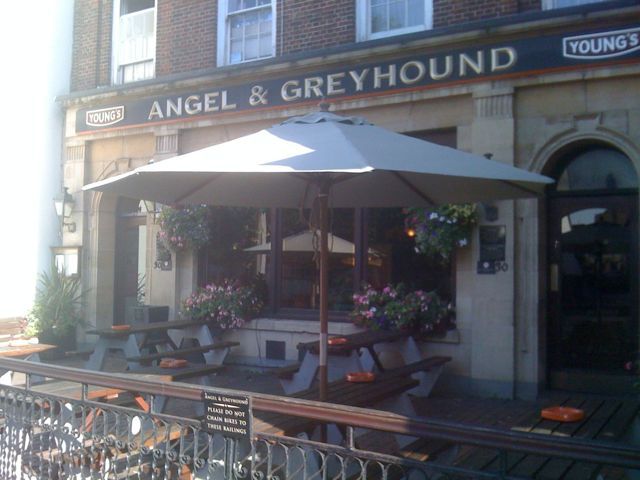
Below is a photo of The Angel and Greyhound, a lovely pub where I had some more Real Ale last night. I tried a beer called Iceberg from the Titanic Brewing Company. Cheers!

Real Ale in London

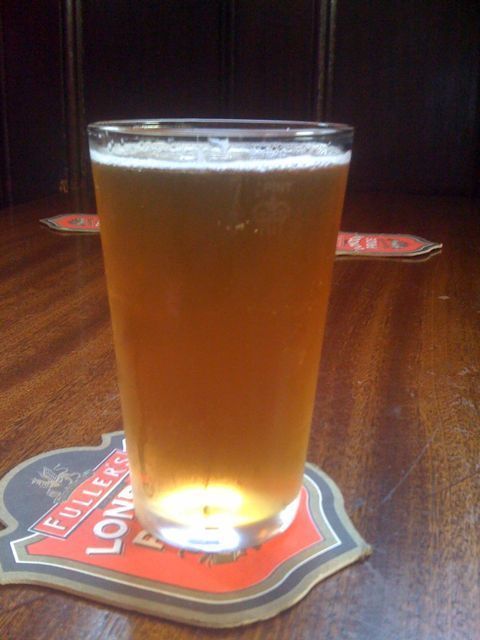
I’m testing the iPhone WordPress app to see if I can post from the road. Here’s a photo of a half pint of Fuller’s Discovery Blonde. I drank this real ale at the Red Lion in Ealing. The pub stands right across the street from the old Ealing Studios and its walls are covered with photos of the actors who used to run across for a pint.

fictionwritersreview

Just a quick note to let you know about some other food-related writing I’m doing. The editor of the online literary magazine Fiction Writers Review has asked me to do an occasional series about food and fiction called “Novel Dishes.”

For each series we’ll choose a novel where food is an important theme, supporting the plot and driving it forward. Each piece will include at least one recipe based on food described in the story. The first book I’m cooking from is Audrey Niffenegger’s The Time Traveler’s Wife. We begin with a cocktail, so come on over and join us for a drink.

A Cookie Alphabet / photo by Christian Guthier

A Cookie Alphabet / photo by Christian Guthier

In my last post I wrote about the Oxford Symposium on Food and Cookery which I’ll be attending next week.

As well as feeding the mind, the symposium is known for special meals that are created in accordance with each year’s theme. This year on Friday evening, Fergus Henderson, chef of world renowned St. John Restaurant, will cook a meal based on the Diaries of Samuel Pepys. It will be followed by a traditional banqueting course of of jellies (that’s jello to us Americans) representing the Great Fire of London, by Bompas & Parr, a pair of young “jellymongers” who have recently set up shop in London (I’ll try to get some photos, I promise). Saturday night’s dinner will be created by Chef Raymond Blanc of Le Manoir Aux Quat’Saison, a well known French restaurant in nearby Oxfordshire, and will highlight the language of French gastronomy, from the raw to the cooked.

Each year there is also a benefit picnic to raise money for the non-profit organization which runs the symposium. The 2009 picnic will be modeled after the “Oxbridge Luncheon” in Virginia Woolf’s A Room of One’s Own.

If everything works out technologically, I will post brief reports from the symposium here on Comestibles and on Twitter, so as they say, stay tuned. I’m also looking forward to Real Ale, classic pub food and ancient British cheeses while I visit the Cotswolds.

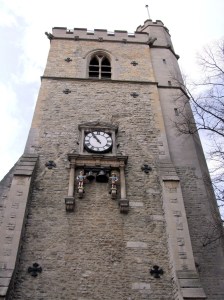
Carfax Tower, Oxford / photo by Jim Linwood

Carfax Tower, Oxford / photo by Jim Linwood

Last year one of my favorite bloggers, Janet Clarkson over at The Old Foodie mentioned that she was going to a Symposium in Oxford, UK all about food history. I was thrilled to find out that such a thing existed and put it on my list of things to do really soon.

Well, really soon is here. Later this week I leave for the UK for two weeks. The symposium itself is only for a few days but I couldn’t resist spending a little time in London first and then, well Oxford is right next door to the Cotswolds which I’ve never seen, so why not turn it into a vacation?

The Oxford Symposium on Food and Cookery is an event which has been held annually since 1981 (although smaller versions of it took place as early as 1979). It was originally founded and co-chaired by the late Alan Davidson, food historian and author of The Oxford Companion to Food and Dr Theodore Zeldin, a celebrated social historian.

From the very beginning the attendees (or symposiasts if you like) have been a curious mix of people from many different professions including of course historians, chefs and cookbook writers, but also mathematicians, chemists, and amateur enthusiasts of all stripes. Davidson and Zeldin realized immediately that they had hit upon a very inter-discipinary topic that needed a place for everyone to come together and share their ideas. The Oxford Symposium on Food and Cookery became that place. It sure sounds like food history geek heaven to me.

Each year a broad subject is chosen to focus the discussion. Past subjects have included: Eggs, Nurture, The Meal, Wild Foods: Hunters and Gatherers, and Food and Morality. This year the theme is Food and Language. A call for papers went out months ago and over 40 people will be presenting their work over the course of the symposium. To whet your appetite, here are some of the papers being presented: “Sex, Food, and Valentines Day: Language of Food – Language of Love: A linguistic analysis of Valentines Day menus in a selection of Parisian restaurants at present”; “Toward a Phenomenological Semiotics of Cuisine: Neanderthal Pictographs as a Universal Language of Cooking”; “The Rhetoric of American Restaurant Menus and the Use of French”; “Telling Porkies: The Nomenclature of the Pig and its Parts”; and “Hidden Voices from the Culinary Past: Oral History as a Tool for Food Historians”.

Before I leave for the UK, I’ll be posting more here about the proceedings, including a description of the the rather extraordinary meals which are scheduled, so come back and visit.
a

I like to poke around in the forgotten corners of food history learning what people ate, and how they cooked differently than we do now. Some, like anthropologist Richard Wrangham, say it is cooking that made us human. What better way to learn about people from different places and time periods than by cooking and eating their food? Here I’ll be writing about kitchen experiments with old recipes, preservation and waste prevention techniques of the past, and unfamiliar ingredients. I’ll also include travel pieces exploring the food history of my destinations, and some beginner attempts at food photography.

It’s important that information about traditional foodways not be lost. It can be useful to us today, making our food choices more environmentally friendly, healthier for our bodies and easier on the wallet. Renewed interest in knowing where our food comes from and the resurgence of farmers’ markets and community supported agriculture is making it easier than ever to incorporate these ideas into our daily routines.

I’ve read that in Greece when γιαγιά (that’s grandma in Greek) makes yogurt at home, she doesn’t use a thermometer to tell if it has cooled to the right temperature. Instead she dips her finger in the hot milk and if she can only keep it there for 20 seconds then it’s time to add the starter. These are the kinds of tidbits I hope to unearth and share with my readers.

Thanks for visiting and I hope to see you again soon.