Feeds:
Posts
Comments

Posts Tagged ‘Food History’

I find there is no better way to get to know a culture than by cooking some of its festival food. When I saw a recipe in Margaret Shaida’s absorbing historical cookbook, The Legendary Cuisine of Persia, for a special rice dish, traditionally served at weddings in Persia, I couldn’t resist. Not only does it describe a way of cooking rice I was completely unfamiliar with, but one of the ingredients is dried rose petals.

The ancient land of Persia has influenced cuisines all over the world for the last 3000 years. Many dishes that we might think of as Arab, Indian, or even European originally came from Persia. For example the candy that we call “Turkish Delight,” is rAhat loqum in Farsi which, liberally translated, means “goes down easily,” which it certainly does!

Lemons, saffron, pomegranates, and pistachios were first brought to the west when the armies of Alexander the Great returned from their conquest of Persia in the 4th Century, BCE.

After the death of Alexander, the Persians reasserted their dominance and created an Empire which would last almost 1000 years, including Baghdad, eastern Iraq, Afghanistan, parts of Pakistan and the eastern half of what is now Turkey. This vast empire lay at the crossroads of the east, forming a bridge between the classical Roman and Greek world and the mysterious exotic lands of India and China.

The Arabs conquered Persia in the late 7th Century, CE. Many historians remark that while Islam was eventually accepted by many Persians, causing a sharp decline in the indigenous religion of Zoroastrianism, the Persians largely kept many other aspects of their culture, including their food, intact. In fact, their Arab conquerors were so pleased with what they found on the tables of Isfahan and Ctesiphon (modern Baghdad), they proceeded to take many ingredients and dishes along with them as they swept into power in North Africa and the Iberian Peninsula.

Later, knights returning from the the crusades in the 12th and 13th Centuries brought stories and examples of aromatic ingredients they had sampled in the east, many of which had been absorbed into Arab cuisine from the Persians. Once tasted, these exotic (and expensive) flavors were craved by the European aristocracy, and thus began the search for route to the east where they might obtain these treasures for less. Who knows, America might never have been discovered if it weren’t for the European love of these exotic spices.

The Moghul emperors of India were actually the descendants of Muslim Mongols who had galloped down from the Steppes and conquered almost all of Persia in the 14th Century, and then stayed and became Persian in culture, language and food. The influence of Persian cuisine can be felt in several regions of India to this day.

I won’t lie, this recipe is fussy, you can imagine an entire family of mothers, daughters, sisters and aunties, in the kitchen taking care of all the details involved. But that’s exactly what festival food is all about, bringing everyone together for a celebration.

Ms. Shaida recommends serving Jeweled Rice with a some very simple chicken. I steam/sauteed some chicken breasts with salt, pepper and onions and a little liquid saffron (see below), but any simply flavored chicken will do, the rice is very complex and needs an almost silent partner.

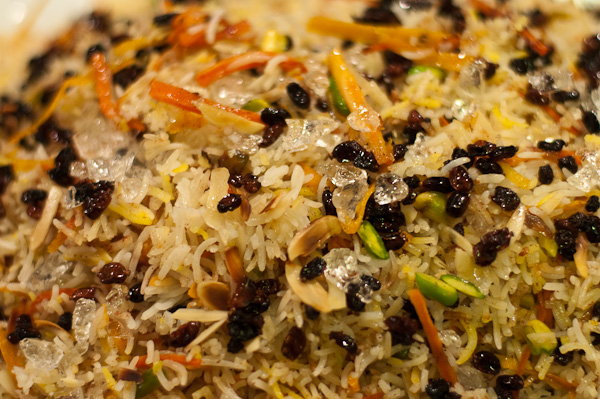
The visual impact of Jeweled Rice is really worth all of the fuss, the ingredients are cut to be symmetrical and complimentary in color and shape. It does taste sweet, but it’s not too much, with the barberries providing a tart contrast. And what a display of wealth; just imagine the cost of the cinnamon, sugar and saffron for a Persian family of the past.

This very special dish is like precious jewels spilled onto a silken pillow, with glowing red barberries playing the part of rubies, pistachio emeralds, and finally a sprinkling of crushed rock candy diamonds, all accompanied by the scent of saffron, orange peel, and rose petals, conveying wishes of a rich, sweet life to the newly married couple.

Jeweled Rice

Adapted from Margaret Shaida

Serves 4 to 6

The unfamiliar ingredients such as the barberries (zereshk in Farsi) can be found at shops specializing in Indian ingredients. Kalustyan’s in New York, sells them via mail order.

1 pound good quality basmati rice
coarse sea salt, or kosher salt

4 teaspoons liquid saffron (see below for recipe)
1 pound carrots
granulated sugar
3 small oranges
2 tablespoons unroasted, unsalted pistachios
2 tablespoons blanched almonds
2 tablespoons dried currants
2 tablespoons dried barberries
1 teaspoon Persian spice mixture (see below for recipe)

vegetable or peanut oil
¼ cup clarified butter or ghee, melted
2 tablespoons of crystalized sugar, aka rock candy

Wash the rice in 2-3 changes of cool water and drain. Put a cup of fresh water in a bowl, along with 2 tablespoons of coarse sea salt or kosher salt and stir until the salt is mostly dissolved. Pour the washed rice into the bowl and add more water until the water is about 1 inch above the level of the rice. Allow the rice to soak for 3 to 6 hours.

Peel the carrots and cut them into julienne strips about 1½ inches long and ¼ inch wide. Put a little oil in a saute pan and fry the carrot strips over medium heat for about 10 minutes, stirring constantly. Stir in a tablespoon of granulated sugar, two teaspoons of liquid saffron, and 2-3 tablespoons of water. Cover and cook for 4-5 minutes, or until the liquid is reduced. The carrot strips will turn a darker shade of reddish-orange from the saffron.

Use a vegetable peeler to peel the oranges, be careful to only take the orange part of the peel and not the bitter, white pith. Cut the peel into julienne strips as you did the carrots. Put the orange peel strips into a small saucepan and cover with cool water. Bring to a boil and then strain. Do this twice more, to get rid of any bitter flavor in the peels.

Blanch the pistachios in boiling water and squeeze them out of their skins. Then soak in cool water along with the blanched almonds for about ½ hour to soften them. When soft, cut the nuts into slivers. Take 1 teaspoon of the almond slivers and toast them in a dry saute pan until browned (be careful not to burn them, they will brown quickly). Put the browned almonds in a separate bowl along with 1 teaspoon each of blanched almond slivers and pistachio slivers. This will be used to garnish the rice at the end. We’ll be adding a few other things to this “garnish dish” as we go.

Put ⅓ cup water in a small saucepan with 1 tablespoon of granulated sugar, heat on low, stirring until the sugar dissolves. Add the remaining nuts and orange peel to the sugar syrup and stir. Bring to a boil and cook for 30 seconds. Strain the nuts and peel and reserve the syrup.

Soak the dried currants in warm water for 10 minutes and strain. Add 1 teaspoon of them to the garnish dish.

Pick over the barberries, to remove any extraneous vegetable matter, then fry them gently in just a little bit of oil for a couple of mintues, until they turn bright red. Be careful not to overcook them, as they burn easily.

After your rice has soaked for at least 3 hours, drain it.

In a 3-quart saucepan bring 2 quarts of water with 2 tablespoons of coarse sea salt or kosher salt to a boil. Pour the washed rice into the boiling water. Bring it back to a boil and cook for 2-3 minutes. At 2 minutes taste the rice, if it is done it should be soft on the outside but quite firm in the center. When it is done strain the rice and rinse it with tepid water.

Rinse out the 3-quart saucepan, return it to the heat and add ½ cup of vegetable or peanut oil and 2-3 tablespoons of water. When the pan is sizzling, sprinkle one layer of rice onto the bottom of the pan. It is important to sprinkle the rice as it separates the individual grains which helps in the steaming process. If it is too hot to handle, use a serving spoon to shake the rice into the pan.

Next sprinkle a layer of the carrots, orange peel, nuts, currants and spice mixture on top of the rice in the pot. Next sprinkle another layer of rice and then another layer of carrots, orange peel, nuts, currants and spice mixture. Continue in this manner, making layers, creating a conical shape in the pot, finishing with a layer of rice.

At this point, pour the reserved sugar syrup over the rice along with the remaining liquid saffron.

Use the handle of a wooden spoon to poke 2 or 3 holes in the rice, all the way to the bottom of the pot. Wrap the cover of your pot in a kitchen towel and place it on the pot. Cook on high heat for 2-3 minutes and then lift the lid slightly to see if it is steaming. You want to see a large amount of steam coming up, if not, cover and cook for another couple of minutes. Once you have lots of steam turn the heat down to low and cook for 30 minutes covered with the cloth-wrapped lid.

After 30 minutes, the rice is done, however, if you have other things to prepare, it can be left over low heat for up to an additional hour without causing any harm.

When you are ready to serve it, fill your sink with a couple of inches of cold water and put the covered hot pot of rice in it for about 2 minutes. This will cause a final burst of steam and help to loosen the rice at the bottom of the pot.

Gently toss the rice in the pot to mix the layers, don’t scrape too far down in the pot, leaving the browned rice at the bottom intact, this will be served separately.

To serve, sprinkle the rice onto a platter, creating a pleasing mound. Garnish the rice by sprinkling over all the items in the garnish dish, plus the barberries. Pour the melted clarified butter over the rice. Finally, crush the rock candy into “diamonds” and sprinkle over the rice.

Go back to the pot once more and use a spatula to pry the crunchy, browned rice disk from the bottom and serve it on a separate plate, don’t worry if it breaks into pieces. In Persian homes, this is considered a delicacy, fought over by everyone, and sometimes it doesn’t even make it from the kitchen to the table.

Serve with a some very simply flavored chicken breasts, leaving the rice to be the star of the show.

Liquid Saffron

The best saffron in the world is grown in Iran and costs about $175/ounce. But an ounce is a lot, since a little goes a long way. Less expensive saffron is available from Spain, India, Greece, Azerbaijan, Morocco, and Italy, so shop around.

20-30 strands of saffron
sugar
tepid water

Make sure your saffron threads are quite dry, if not put them in a warm (not hot or they will burn!) oven for 2-3 minutes to dry them out. Put the saffron in a mortar with a small pinch of sugar, and use the pestle to pulverize them into a fine powder. Add 4-5 teaspoons of tepid water and let stand. Within 15-20 minutes the liquid will turn a dark orange color and is ready to use.

Persian Spice Mixture

Removing the seeds from cardamom pods can be tedious. Shops like Kalustyan’s, which sell Indian ingredients, will often have unground cardamom seeds, which is a lot easier. They are also a good source for the dried rose petals, which might be shelved with the teas.

¼ cup unroasted, unsalted pistachio nuts
2 tablespoons ground cinnamon
2 teaspoons cardamom seed
3 tablespoons dried rose petals
10 threads of saffron

If you have a spice grinder, put all of the ingredients in it and grind them coarsely. Otherwise, pulverize the pistachios in a food processor, roughly crush the cardamom seed, rose petals and saffron together in a mortar and pestle and then mix them together with the cinnamon and ground pistachios.
Read Full Post »

Oh, to be in the souk bargaining with an olive merchant, while chickens destined for the pot scurry around your feet. I’ve never been to Morocco, but if the mysterious flavors of its cuisine are any indication, I must visit. One of the classic combinations is a tagine of chicken with lemon and olives.

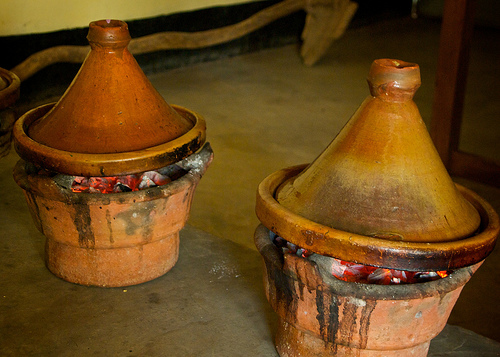
A tagine is a North African clay cooking vessel, with a tall conical cover that looks a bit like a sorcerer’s hat. The shape of the top encourages condensation, keeping the food inside moist as it cooks. Tagine is also what you call the dish that is cooked in said vessel, usually a slow braise of meat, poultry or fish with fruits, vegetables and exotic spices.

Tagines cooking over charcoal fires / photo by Flickr user John Mather

Essentially, a tagine is a stew, and so is Morocco. Separated from Europe only by the narrow Strait of Gibraltar, it has long been one of the great crossroads of the world. Many peoples have come and gone over thousands of years, each leaving an influence on the culture and the food.

The first inhabitants were the indigenous North Africans, the Berbers, or as they call themselves, the Imazighen. As early as the 6th Century, BCE, Phoenician traders established colonies in what is now Morocco. The next group to add their spice to the pot were the Romans. In fact, several famous Romans are known to have been Berbers, including the author Apuleius and the great church father Saint Augustine. In the 7th Century, CE, the Arabs conquered what is now Morocco, introducing Islam to the local Berber population. Over the next 800 years there was much influence, culinary and otherwise, from the Iberian peninsula whence many Muslims and Jews fled as the European Christians slowly re-took area from the Arabs. The Portuguese had an additional brief influence in Morocco during the early 16th Century as they spread their wings to explore the globe.

In the late 19th Century, France and Spain turned their eyes to Morocco’s weak government, expressing concern about instability in this geographically strategic area. These countries were also very interested in expanding their colonial powers and Morocco was a known source of wealth. By 1912, most of Morocco was declared a French Protectorate with a smaller Spanish Protectorate in the northern part of the country. This remained in place until 1956 when Morocco gained its independence.

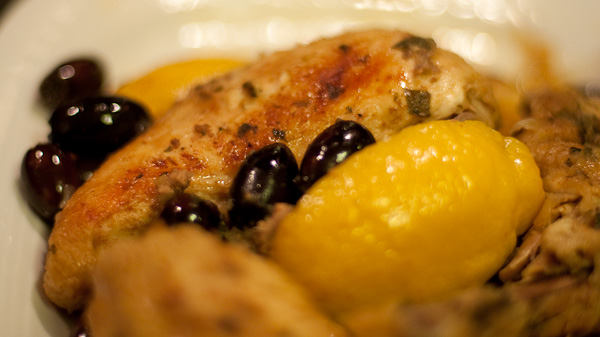
For a dish with so many strong flavors this version of chicken with lemon and olives (called Djej Emshemel in Morocco) is surprisingly subtle and well balanced. The preserved lemons (do cut them up and eat them, peel and all) are like a burst of perfume in the mouth, and the mashed chicken liver in the sauce anchors the whole dish with a rich bass note. This one is definitely going on the dinner party list. While the total cooking time is on the order of two and a half hours, most of that is not active time in the kitchen, leaving you with plenty of time to set the table and put the flowers in a vase.

In a traditional Moroccan meal you might begin with some refreshing salads, perhaps an eggplant puree with cumin and paprika, and maybe a Spanish-influenced mixture of tomatoes and roasted green peppers with preserved lemon. Outside of Morocco, tagines are often served with couscous, but according to Moroccan food expert Paula Wolfert, the couscous, which has been steamed over, and eventually combined with, a lamb broth including meat and vegetables, is traditionally served at the end of the meal. The most appropriate thing to serve with the tagine is flat, round, moroccan bread which is fairly easy to make at home. If you have access to a middle eastern bakery, Turkish bread is fairly similar, or in a pinch, nice fresh pita bread will do for soaking up the rich, lemony sauce.

Tagine of Chicken with Lemon and Olives

Adapted from Paula Wolfert

Serves 4

If you don’t have a tagine (the pot), you can still make a tagine (the food). A heavy dutch oven with a cover works very well. You can find preserved lemons in specialty food shops, and they are also very easy to make yourself.

1 chicken and its liver
3 cloves garlic, peeled
kosher salt and sea salt
½ teaspoon ground ginger
½ teaspoon sweet paprika
⅛ teaspoon ground cumin
⅛ teaspoon freshly ground black pepper
¼ cup vegetable oil or peanut oil
1¼ cups grated onion, drained
⅛ teaspoon pulverized saffron
¼ cup mixture of chopped fresh cilantro and parsley
¾ cup ripe Moroccan olives in citrus juice or Royal-Victoria or Kalamata olives
1 preserved lemon
1-2 fresh lemons

The day before serving, cut the chicken into 4 pieces, wash the pieces in salted water, and drain. Use a mortar and pestle to make a paste using 2 of your cloves of garlic and 1 tablespoon of kosher salt. Rub the chicken pieces with the paste, then rinse the paste off under cool running water until the garlic smell is gone. Drain. This is a traditional Moroccan way of preparing poultry for cooking which is said to remove bitter flavors and bring out the taste of the chicken.

Make a marinade by mixing together the following: the remaining clove of garlic, thinly sliced, ½ teaspoon of sea salt, the ginger, paprika, cumin, black pepper, and vegetable or peanut oil. Coat the chicken and the chicken liver in the marinade, cover and chill for 24 hours.

Put the chicken, its liver, and the marinade in a heavy dutch oven. Gently pulverize your saffron threads in a mortar and pestle. When you have ⅛ of a teaspoon, pour a little water in the mortar and let it stand a moment. Add ¼ cup of the grated onion to the dutch oven along with the saffron water, cilantro and parsley, and 1½ cups of water. Bring it to a boil and then turn the heat down to a simmer and cover. Turn the pieces of chicken frequently in the liquid while simmering for 30 minutes.

While the chicken is simmering, pit the olives if necessary and rinse and drain them.

When the chicken has finished simmering, remove the chicken liver from the casserole and mash it finely. Return the liver to the pot along with the rest of the grated onions. Check the level of the braising liquid and add some water if it doesn’t come halfway up the chicken pieces. Partially cover the pot and simmer until the chicken is very tender and the meat is falling from the bone, about an hour and a half.

When the chicken is done, rinse the preserved lemon and quarter it. Add the preserved lemon and the olives to the pot and cook for about 10 minutes, uncovered, to combine the flavors.

Remove the chicken pieces, olives, and preserved lemon to a serving platter, cover to keep warm.

Turn the heat up and reduce the sauce to about ¾ cup. Add the juice of 1 fresh lemon to the sauce. Taste it and adjust the seasoning with salt and/or more fresh lemon juice if necessary.

Pour the sauce over the chicken and serve.

Read Full Post »

While visiting Australia I had a chance to catch up with one of my favorite food history bloggers Janet Clarkson of “The Old Foodie”. We had a great visit, diving into her terrific collection of historical cookbooks, including her latest work: Menus from History: Historic Meals and Recipes for Every Day of the Year.

I thought it would be fun to cook a historic recipe together and she suggested choosing something from The English Art of Cookery by Richard Briggs, which was published in 1788. That year holds importance for both Australia and the State of New York, where I live. In Australia, it marks the arrival of the first European settlers at Botany Bay. In New York State, the legislature ratified the US constitution.

Sometimes historic cooking can be complicated and require lots of obscure ingredients. Luckily, we were able to find a recipe where we had almost everything on hand. Queensland, where Janet lives, is known for the superior quality of its seafood, so we decided to make something with prawns (that’s shrimp to us Americans). We headed out to Janet’s local farmers’ market and bought some right from the fisherman.

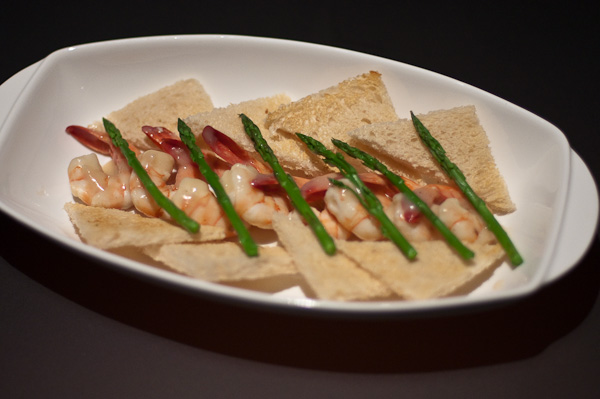
The prawns were fresh and toothsome, and the sauce is an intriguing mix of spicy horseradish and almost sweet mace and nutmeg. Over all we thought it was quite successful. It goes nicely with asparagus, which we had on the side, and you also might consider sprinkling some freshly chopped parsley or dill over the prawns for a nice green component.

Stewed Prawns

Adapted from From The English Art of Cookery by Richard Briggs (1788)

1 pound Prawns
1 cup wine
½ cup water
1 blade of mace
1 tablespoon horseradish (or more to taste)
¼ teaspoon salt
1 tablespoon butter
1 tablespoon flour
¼ teaspoon grated nutmeg
2 slices toasted white sandwich bread cut in triangles

Peel the prawns except for the tails. Put the wine, water, mace, salt, and horseradish in a medium saucepan and bring it to a simmer. Add the prawns and cook covered until pink and cooked (about 5 minutes) be careful not to over cook them. Strain the prawns and reserve the cooking liquid, keeping it hot. Melt the butter in a medium saucepan, then whisk in the flour and stir for 2-4 minutes or until the flour turns slightly blonde. Pour in the hot cooking liquid and continue whisking. Add the nutmeg and continue whisking until the sauce thickens. Reheat the prawns in the sauce, and serve garnished with the toast points.

Read Full Post »

The other day one of my favorite food writers, Michael Ruhlman, began musing on Twitter about why he cooks. He then wrote a blog post about it and encouraged others to follow suit. Here are my thoughts.

Cooking is a magical window onto other cultures. In particular, for me it is a window onto the past. As L.P. Hartley once wrote, “The past is a foreign country: they do things differently there.” Cooking is a way of traveling through time and space without leaving the confines of my kitchen.

I remember a foggy morning in France, when a friend and I were standing, tickets in hand, waiting for the gates of a chateau to open. There was a vendor selling fresh, hot croissants so we bought some and had just started eating them when the guard came along with his big set of jangly keys. As he collected our tickets and waved us through into the gardens, he didn’t say bonjour or merci, instead he said, “bon appetit!” It was at that instant I truly understood the place of food in the French heart. I haven’t made croissants myself (yet!), but when I do, I’ll be brought right back to that moment.

Cooking is a time machine. Cooking and eating historic dishes is way to get inside the heads of people who lived well before I was born. What better way to imagine what it was like living in the Massachusetts Bay Colony in the 17th Century than by cooking up a pot of Baked Beans? Until I researched and cooked that recipe, I didn’t know the dish was crafted so a Puritan housewife could put it in the ashes of the fire on Saturday night, eliminating the need for cooking on the Sabbath. That’s one of the reasons the recipe contains molasses, it’s an acid which prevents the beans from becoming mushy over the course of their long slow bake.

In October, 2009 a friend generously gave me some some pig offal left over from her meat CSA. I went straight to Madeleine Kamman and her recipe for Grosse Cochonnailles or Coarse Country Pâté. Before World War II, at that same exact time of year, French villagers in Brittany would slaughter their pigs and make a myriad of dishes using every bit. I didn’t have a whole pig but, I got a chance to peep into that world by making the pâté and cooking Fergus Henderson’s Pot-Roast Half Pig’s Head.

Until those geniuses at MIT and Stanford figure out how to make a real time machine, I’ll be here cooking my way through history. I read recently, that we have some 4,000 year old cuneiform tablets with recipes on them from Mesopotamia, how cool is that? Ancient land of Ur, here I come.

Read Full Post »

In his book In Defense of Food: An Eater’s Manifesto, Michael Pollan writes that that stone ground flour is more nutritious than flour made in a mill equipped with metal or porcelain rollers. The thing that really surprised me is that he wasn’t just saying that whole wheat flour is healthier (which it is), but that white flour ground with stones is healthier than white flour ground with rollers.

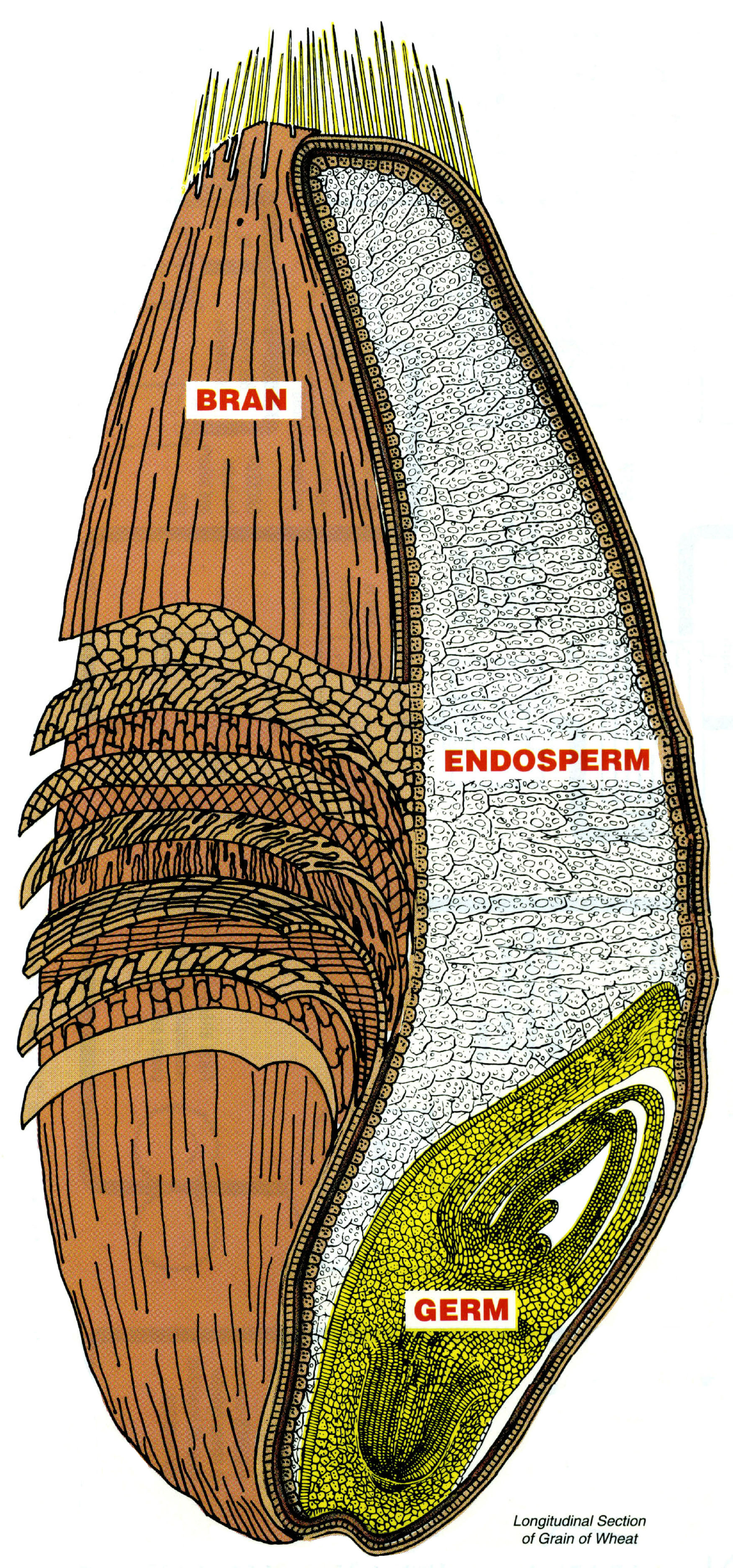
I decided it was time for me to learn a little about the history of flour. After all, it’s a ubiquitous ingredient, seen in cuisines the world over and humans have been making it for thousands of years. For the purposes of this article I’ll be discussing wheat flour, but of course there are many other flours used in different cultures. First, a little wheat nutrition lesson, and then we’ll explore the different ways there are to make flour. A kernel of wheat has three parts, the bran, the endosperm, and the germ. Here’s an illustration:

Most of wheat’s important nutrients are located in the bran and the germ. The bran contains insoluble fiber (important for digestive health), incomplete protein, some trace amounts of B vitamins, and Iron. The germ is the most nutritious part of the wheat kernel containing protein; vitamin E; almost all of the B vitamins, including folic acid; carotenes and other antioxidants; and omega-3 fatty acids. The endosperm (which is the largest part of the wheat kernel) consists of carbohydrates, incomplete protein and trace amounts of vitamins and minerals.

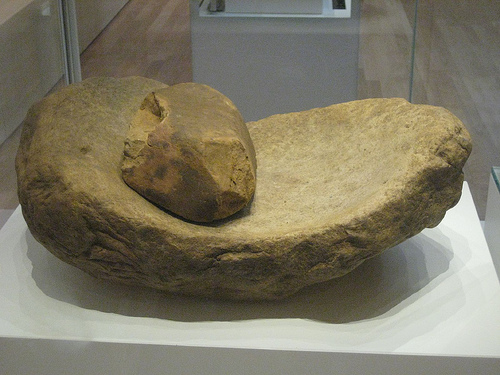
One of the oldest technologies for making flour is the combination of a stone mortar and pestle to initially break the grain, and the saddle quern for grinding it. The saddle quern is an elongated stone with a depression in it where the grain is placed, and then a woman (it was usually a woman) kneels in front of the short end and pushes a smaller stone back and forth over the grain in a rocking motion. It takes a long time to make any useful amount of flour in this manner. In fact, archaeologists examining women’s bones from a Neolithic site in what is now Northern Syria, found many of the women had deformities to their toes, legs, back, and pelvis which can be attributed to spending many hours kneeling in front of a saddle quern. Boy am I glad we don’t have to make flour that way anymore!

A Saddle Quern / Photo by Flickr user unforth

The next development is the rotary quern which consists of two round stones placed on top of each other. The lower stone is slightly convex, and the upper, concave. The top stone has a vertical handle coming from it’s top and a hole in the middle where the grain is fed. The operator (also most likely a woman) uses the handle to turn the top stone, grinding the grain between the stones. The finished flour flows out from between the edges of the stones. Some versions included a spout which would feed the finished flour out into a container. Here’s a great video of someone operating a rotary quern. That still looks like an awful lot of work to get enough flour to make a loaf of bread.

As one might expect, the ancient Greeks and Romans made some important contributions to grain milling technology. The Romans built larger versions of the rotary quern and used animal or slave power to drive them and the ancient Greeks invented the first water mill. A wooden spindle ran from the top stone through the bottom stone. This spindle extended down into a stream and a horizontal water wheel was placed on it. The flow of the water causes the top stone to turn, thus grinding the grain. Eventually the Romans turned the water wheel in the other direction and used gears to transfer the power of the water to the grinding stones. This configuration: a vertical wheel, gears, and two grinding stones working in a rotary manner, remained the predominant method of milling flour until roller mills were introduced in Europe in the 19th Century. There were some changes as to how the stone mills were configured and powered, but essentially the technology was the same for almost 2000 years.

A Model of a Roman Water-powered Grain Mill as Described by Vitruvius (born c. 80–70 BCE, died after c. 15 BCE)

The latest development in flour milling I’ll discuss here is the replacement of grind stones with metal or porcelain rollers which happened around 1870. A mill equipped with rollers uses multiple sets of them turning at different speeds to break the grain and then to grind it. Rollers were faster than grind stones, they produced more flour from a pound of grain and they produced a product with a longer shelf life (more on that later). So it makes sense that the millers of 19th Century Europe and America would jump at the chance to convert their mills to this new technology that would help them make more money and increase their customer base. In fact, in only took about 10 years for most stone mills to be replaced by rollers.

A Modern Flour Mill / Photo by Kate Waxon

So, how do these different milling technologies affect the nutrition of the flour? At some point people discovered they could separate the bran and the crushed pieces of germ from ground wheat fairly easily by sifting it through cloths of an appropriate weave. In Medieval England this was called “boulting” and by using multiple cloths of differing weaves quite fine flour could be made which contained little bran and germ. However this “white” flour still contained the oil from the germ which was released when the germ was crushed during milling. Wheat germ oil, being rich in beta carotene, gave a yellowish gray cast to the flour. The oil also began to oxidize as soon as it came into contact with air, which meant that this “white” flour would only stay fresh for about six months, after which time the wheat germ oil would turn rancid, affecting the taste.

This all changed when rollers were introduced. When grain passes through two rollers moving at different speeds the slower one holds it and the faster one strips it. This meant that not only could the outer bran of the grain be removed as could be done with stone milling, but the germ could be scraped off before grinding. And so was created the first truly white flour, ground solely from the endosperm of the wheat. It was a snowy white and due to the lack of wheat germ and wheat germ oil, it had double the shelf life of the old style “white” flour. Before roller milling was introduced, “white” flour was very expensive and only affordable to the wealthy. The poor used what we would call whole wheat flour today and the truly poor could only afford rye or barley flour. Once roller mills made it more affordable, white flour’s popularity exploded and everyone felt wealthy to have it.

Unfortunately, the lack of nutritional knowledge at the time, meant that millers didn’t understand that in removing the germ from their flour they were taking away a major source of vitamin B, especially from the poor for whom bread was the main source of nourishment. Once roller mills became ubiquitous we see a higher incidence of diseases caused by lack of B vitamins such as pellagra and beriberi.

Once the requisite vitamins were discovered and better understood (during the 1930s) we began enriching some of our flour with Iron, Niacin, Thiamine and Riboflavin. Folic Acid was added to the list in the 1990s. These are of course the nutrients contained in the wheat germ which was removed during the roller milling process. In stone ground “white” flour there is no need for enrichment.

Having learned some of the history of flour milling and how it affects our nutrition, I would now like to bake some bread with stone ground “white” flour and compare it to bread made with good quality all purpose, unbleached, roller milled flour. I’m curious to see if the flavor, color or texture is different. After a cursory bit of looking around, there seems to be plenty of stone ground whole wheat flour available in the US, but hardly any stone ground “white” flour. So far I’ve only found it at Wade’s Mill in Virginia and Central Milling in Ogden, Utah. I might consider mail ordering some from them, but since freshness is so important, I’d really rather get it locally. Please contact me if you have any sources in the New York tri-state area and stay tuned to read the results of my bread baking experiments.

Sources:
Campbell, Judy, et. al. “Nutritional Characteristics of Organic, Freshly Stone-Ground, Sourdough and Conventional Breads” in Ecological Agricultural Projects (McGill University, Quebec, Canada, 1991)
Elton, John “Evolution of the Flour Mill, From Prehistoric Ages to Modern Times” in Souvenir of the First International Miller’s Congress and Annual Convention of the National Association of British and Irish Millers (Paris, 1905)
Hazen, Theodore, R. “How the Roller Mills Changed the Milling Industry” in Pond Lily Mill Restorations
Pollan, Michael. In Defense of Food: An Eater’s Manifesto (New York: The Penguin Press, 2008)

Read Full Post »

pavilion

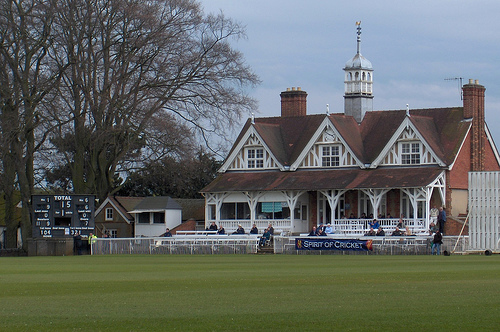
Oxford Cricket Pavilion / photo by bishib70

In September I went to food history geek wonderland, namely the 2009 Oxford Symposium on Food and Cookery. It was my first time attending and if you’re thinking about going next year, I highly recommend it.

Each year the Symposium has a theme, alternating between concrete and abstract ideas. For example, this year’s theme was “Food and Language,” an abstract idea, and next year will highlight the more concrete “Cured, Fermented, and Smoked Foods.”

The event is put on by the Oxford Symposium Trust which holds a fund raising picnic each year on the first day of the Symposium. This year to go with the theme, the picnic was based on the Oxbridge Luncheon in Virginia Woof’s book A Room of One’s Own. It was held at the University Parks Cricket Pavilion (see photo above).

The menu was created by Elisabeth Luard, Geraldene Holt, and Derek Muircroft. The gathering was particularly decorated by the presence of Mrs. Woolf herself, in the personage Ms. Ellie Piercy, late of the Globe Theatre. She was received with much enthusiasm by the assembled crowd as she read from A Room of One’s Own and some of her letters; including one to her sister in which she described the stressful day she had to sack her cook. The menu was as follows:

Individual game pies served with spiced pear chutney, salmagundi, and potato salad with Old English Salad Cream.

Glorious Fruits and Friandises

Isis and other cheese by the Oxford Cheese Company

Rice puddings by Mrs. Geraldene Holt

Accompanying wines donated by Penfolds, Peter Lehmann, and Yalumba

It was a lovely late summer day and the historic surroundings only added to the bonhomie. I found my fellow symposiasts — some of whom are very well known in the food world — very welcoming, encouraging this new comer to plunge right into the lively conversation.

Despite the exquisite game pies, I tried to eat lightly because I knew dinner that evening was going to be a real treat. Chef Fergus Henderson, of St. John Restaurant in London, created a dinner based on the diaries of Samuel Pepys, in honor of Harlan Walker, the long-time editor of the Symposium’s proceedings.

Here’s the menu:

Parmesan Cheese Straws and Champagne

Ox Tongue & Beetroot
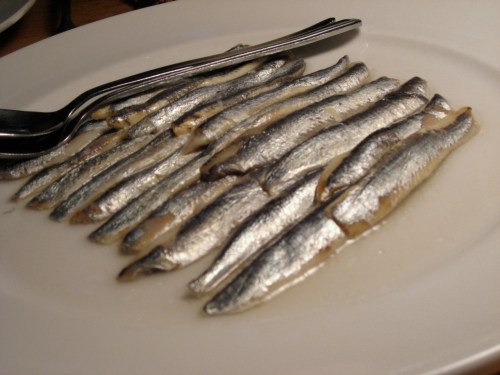
White Pickled Anchovies
Bottarga
Bread and Butter
Served with Solear Manzanilla (Bodegas Barbadillo, SL)

Venison & Trotter Pie
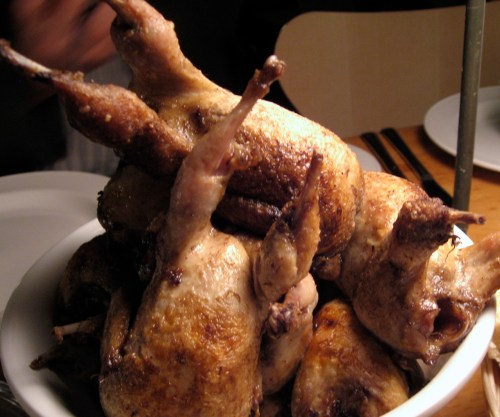
Roast Quail
Boiled Leg of Mutton with Caper Sauce
Fricasée of Rabbit with Peas
Beef Shins
Whole Roast Jerusalem Artichokes
Served with Château Bahans Haut-Brion 1999 & Clarendelle rouge 2004.

St. Paul’s Aflame by Jelly Mongers Bompas & Parr
Served with Málaga No 1 Selección Especial 2006 & Alvear Solera 1927 Px (Bodegas Alvear)

Mr. Pepys’s diary is one of the few contemporary reports we have of the Great Fire of London in 1666. When he saw that the fire was coming close to his house he dug pits in the garden to bury some of his prized possessions, including his wine and a wheel of parmesan cheese. This is what inspired Mr. Henderson to create the Parmesan Cheese Straws we had for an appetizer.

The food was glorious. It was all served family style at the long tables in the dining hall at St. Catherine’s College, Oxford. It really put me in mind of the “groaning boards” of yore described in historical novels. And best of all, I got to eat it surrounded by historians, cookbook writers, journalists, and food enthusiasts of all stripes. Here are a few pictures, to give you the idea:

anchovies

White Pickled Anchovies

quail

A Bowl of Quail

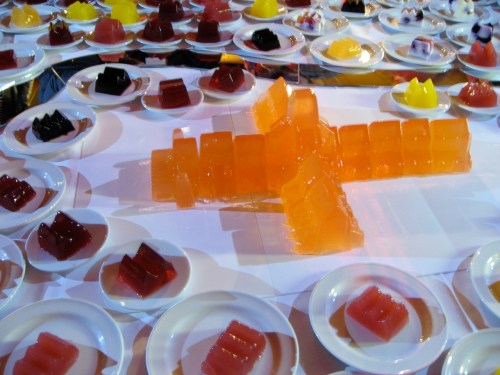
The most exciting part of the evening was the unveiling of the banquet course entitled St. Paul’s Aflame, which was a representation of the Great Fire of London in jelly (that’s Jello to us Americans). It was made by Bompas & Parr, two young men who have recently revived the art of jelly making in the UK.

jelly

St. Paul's Aflame

jellyhouses

Jelly Houses of London

It was presented on a long rectangular table with St. Paul’s Cathedral done in orange jelly; the river Thames represented by curving pieces of mirror traveling down the table; and as far as the eye could see little houses of jelly in different shades of red and orange representing the burning city of London. The jellies were made with natural fruit juices and had just the right amount of sweetness; very different from the neon green Jello of my youth. And of course there was the wobbly factor. After all the wine we had at dinner, we did enjoy poking at our little houses and watching them jiggle.

At this point, the Symposium proper had not even begun! Stay tuned for more reflections on Oxford, 2009 soon.

Read Full Post »

A Cookie Alphabet / photo by Christian Guthier

A Cookie Alphabet / photo by Christian Guthier

In my last post I wrote about the Oxford Symposium on Food and Cookery which I’ll be attending next week.

As well as feeding the mind, the symposium is known for special meals that are created in accordance with each year’s theme. This year on Friday evening, Fergus Henderson, chef of world renowned St. John Restaurant, will cook a meal based on the Diaries of Samuel Pepys. It will be followed by a traditional banqueting course of of jellies (that’s jello to us Americans) representing the Great Fire of London, by Bompas & Parr, a pair of young “jellymongers” who have recently set up shop in London (I’ll try to get some photos, I promise). Saturday night’s dinner will be created by Chef Raymond Blanc of Le Manoir Aux Quat’Saison, a well known French restaurant in nearby Oxfordshire, and will highlight the language of French gastronomy, from the raw to the cooked.

Each year there is also a benefit picnic to raise money for the non-profit organization which runs the symposium. The 2009 picnic will be modeled after the “Oxbridge Luncheon” in Virginia Woolf’s A Room of One’s Own.

If everything works out technologically, I will post brief reports from the symposium here on Comestibles and on Twitter, so as they say, stay tuned. I’m also looking forward to Real Ale, classic pub food and ancient British cheeses while I visit the Cotswolds.

Read Full Post »

« Newer Posts